Scott is locked in the cellar
The Shrinking ManScott Carey is locked in Carey's cellar when Louise Carey returns to work and arranges for a neighborhood girl to watch Beth Carey. The confinement is presented as a solution to an immediate domestic problem: Scott is too small to care for Beth and cannot pass as an ordinary child. But the arrangement also makes him a secret to be hidden from the person entering the household, and the closing lock transforms an accommodation into imprisonment. His reluctant acceptance gives way to terror as the door shuts and the sounds of the routine begin to take shape in his mind.
Background and Cause
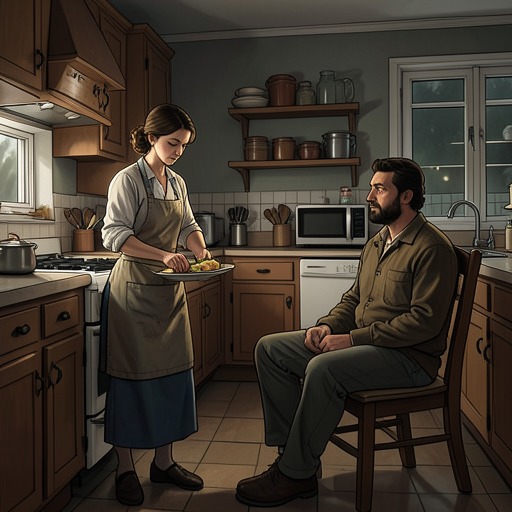
The arrangement follows the end of summer, when the teenage girl who had worked at the lake grocery store returns to school. Louise, who had applied for the opening a month earlier, takes the job. She had vaguely assumed Scott could look after Beth while she worked, but his height—barely reaching Beth’s chest—makes that plan untenable. Scott also refuses to try. Louise therefore hires a neighborhood girl who has left high school to care for Beth, despite recognizing that the added expense will leave the household with little money.
The babysitter’s presence creates a problem beyond childcare. Louise tells Scott he will have to remain in the cellar during the day unless he wants the girl to learn who he is; his appearance cannot plausibly be mistaken for a child. The threat of discovery, rather than any stated danger from the girl, drives the decision. Scott’s silence and shrugging shoulders do not resolve the disagreement: they register his withdrawal while leaving Louise to make arrangements around his condition.
The Cellar Arrangement
After breakfast, Louise accompanies Scott downstairs and brings a lawn chair for him to sit on. Between the fuel tank and the refrigerator, she retrieves a suitcase from a pile of boxes and puts two chair cushions inside it, preparing a place where he can nap. The details make the plan tangible: the cellar is not merely a place he must visit, but a daytime enclosure being fitted out for his use. Scott calls the proposed sleeping place a degrading comparison, while Louise treats it as a practical provision.
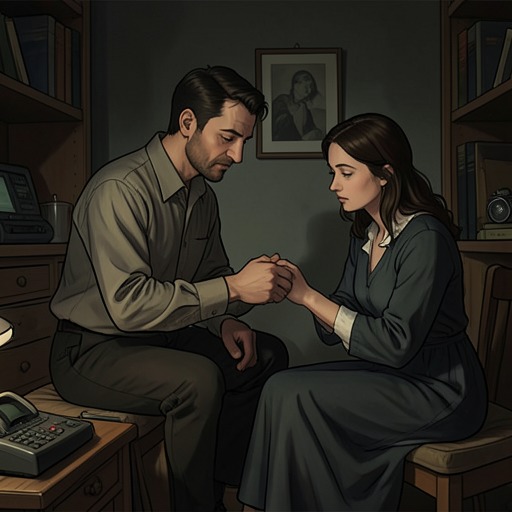
The question of the door makes the difference in their understanding explicit. Louise worries that the girl might be nosy and considers putting the lock on. Scott refuses, insisting that he does not want the door locked. Later, after drinking his coffee while the girl walks around upstairs, he tells Louise to go ahead and lock him in. Her answer recalls that this was his decision and asks whether he wants to risk being found. His change of position is not presented as comfort or agreement; it is a concession to the alternatives Louise has laid out.
The Door Closes
At their parting, Louise kisses Scott on the top of the head. He draws away, and she goes up the steps. Left on the cellar floor, he rhythmically slaps folded newspapers against his leg and imagines the pattern that will recur every day: sandwiches and coffee below, a farewell kiss, Louise leaving, the door descending, and the lock snapping shut. The sequence reduces domestic care to a repeated timetable while placing Scott on the confined side of each departure.
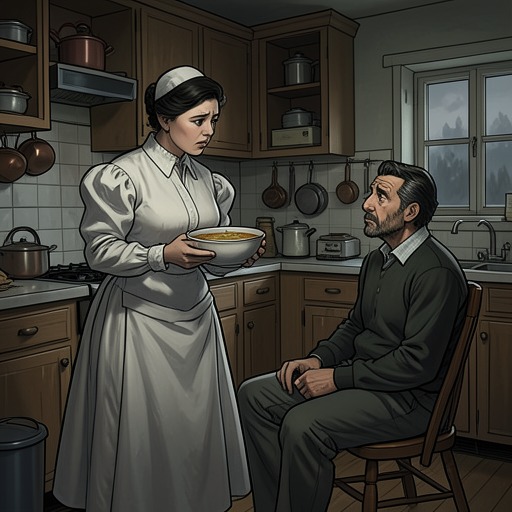
When the lock actually snaps, the anticipated routine becomes an immediate crisis. Scott feels a surge of terror, nearly screams, sees Louise’s moving legs, and presses his lips together to suppress the cry. He understands himself as a prisoner and as a monster hidden by decent people so the world will not learn the secret. The language marks the emotional reversal: a plan he has accepted under pressure becomes a sentence he experiences as exclusion and captivity. After the fear subsides, passive withdrawal returns. He climbs onto the chair, lights a cigarette, drinks coffee, and thumbs through the previous evening’s New York Globe-Post.
Secrecy and Aftermath
The newspaper makes the cellar’s isolation part of a wider public absence. On page three, a short article asks where the shrinking man is and reports that Scott disappeared three months earlier, with no word received from any quarter since. The report does not explain how he came to be concealed in the cellar; instead, its public uncertainty stands against the private fact of his confinement. He is physically present in the household yet absent from the account of the outside world.
The episode’s force lies in this collision between ordinary household logistics and Scott’s altered status. Louise must work, Beth needs care, and the babysitter must not discover him; each practical fact narrows the available choices. Yet the cellar arrangement exacts more than privacy. Its repeated farewells, locked door, and hidden occupant turn the family home into a boundary between those who can move freely upstairs and Scott, whose survival now includes remaining unseen. The newspaper’s unanswered question sharpens that separation: while the world wonders where he has gone, he sits below it, reading about his own disappearance.